The celebration of New Year’s has a rich and complex history that spans thousands of years, with its origins dating back to ancient civilizations. The modern concept of New Year’s as we know it today, however, is a relatively recent development. To understand the evolution of this global phenomenon, we must examine the historical context and various cultural influences that have shaped its development over time.
The earliest recorded celebrations of the start of a new year date back to ancient Mesopotamia, around 4000 BCE. The Babylonians, in particular, observed a festival called Akitu, which marked the beginning of their new year. This festival was tied to the lunar cycle and the agricultural cycle, and it involved rituals and ceremonies to ensure a prosperous new year. The Akitu festival was a significant event, lasting for 11 days, and was celebrated with feasting, gift-giving, and the coronation of a new king or the renewal of the king’s powers.
As civilizations rose and fell, the celebration of the new year evolved and was influenced by various cultures. The ancient Romans, for instance, initially celebrated the new year on March 1, marking the beginning of their military campaign season. However, in 153 BCE, the Roman Senate changed the start of the year to January 1, in honor of Janus, the god of beginnings and endings. This change was likely influenced by the fact that January was a month dedicated to Janus, and the Romans wanted to align their calendar with the solar year.
| Culture | New Year's Date | Significance |
|---|---|---|
| Babylonians | First new moon after vernal equinox | Akitu festival, marking the beginning of the new year and the cycle of nature |
| Ancient Romans | Initially March 1, later January 1 | Marking the beginning of the military campaign season, later honoring Janus |
| Christians | Various dates, including March 25 and December 25 | Initially avoiding pagan celebrations, later adopting and Christianizing existing festivals |
The early Christian church had a complex relationship with the celebration of the new year. Initially, Christians avoided participating in the Roman New Year’s celebrations, viewing them as pagan and licentious. However, as Christianity spread and became more widespread, the early church attempted to eliminate the existing pagan festivals and replace them with Christian celebrations. The date of the new year was not fixed, and different Christian communities celebrated the Epiphany (January 6) or the Annunciation (March 25) as the beginning of the new year.
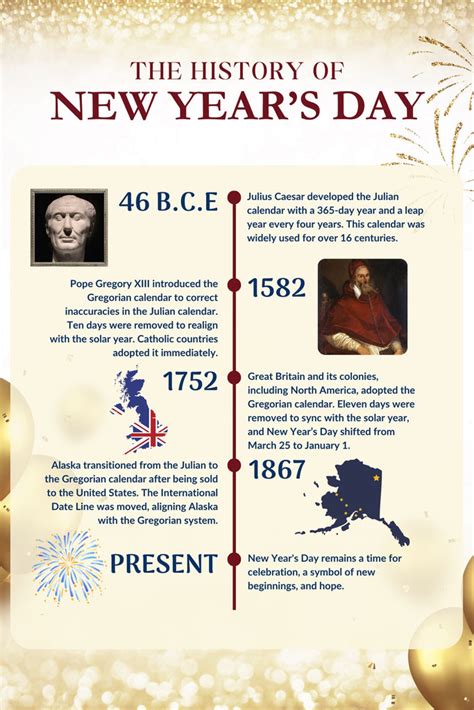
The modern concept of New Year’s as we know it today, with January 1 as the universally accepted date, is a relatively recent development. The widespread adoption of January 1 as the start of the new year can be attributed to the influence of European Christianity and the Gregorian calendar, introduced by Pope Gregory XIII in 1582. The new calendar corrected the drift in the Julian calendar, which had been introduced by Julius Caesar in 45 BCE.
As European colonization and globalization spread, the January 1 date became the standard for many countries around the world. However, it’s worth noting that some cultures and communities continue to celebrate the new year at different times, often tied to their traditional calendars or agricultural cycles.
The contemporary celebration of New Year’s is a complex and multifaceted phenomenon, influenced by a range of cultural, social, and economic factors. The modern tradition of counting down to midnight on December 31, accompanied by fireworks, champagne toasts, and other festivities, is a relatively recent development, dating back to the late 19th and early 20th centuries.
The celebration of New Year’s continues to evolve, reflecting changing societal values, technological advancements, and cultural exchange. As we look to the future, it’s likely that the tradition will continue to adapt and incorporate new elements, while maintaining its core significance as a moment of collective celebration and reflection.
When was the first recorded New Year’s celebration?
+The first recorded New Year’s celebration dates back to ancient Mesopotamia, around 4000 BCE, with the Babylonians’ Akitu festival.
Why did the Romans change their New Year’s date to January 1?
+The Roman Senate changed the start of the year to January 1 in 153 BCE, in honor of Janus, the god of beginnings and endings.
How did Christianity influence the celebration of New Year’s?
+The early Christian church initially avoided participating in Roman New Year’s celebrations, viewing them as pagan. Later, Christianity adopted and Christianized existing festivals, leading to the widespread adoption of January 1 as the start of the new year.
When did January 1 become the universally accepted date for New Year’s?
+The widespread adoption of January 1 as the start of the new year can be attributed to the influence of European Christianity and the Gregorian calendar, introduced by Pope Gregory XIII in 1582.